


The Energy Grid: Why Some People Draw You In While Others Instantly Irritate You

Sometimes you meet someone and relax within minutes. The conversation flows, silences do not feel awkward, and you sense that you do not have to keep explaining yourself.
With someone else, the exact opposite happens. They have barely said anything wrong, yet you already feel resistance. You become restless, critical or tired. Perhaps their speaking pace irritates you. Perhaps it is the way they look at you, hesitate, make decisions or seem unable to move towards anything at all.
Only afterwards does your mind try to explain what you have already felt.
He is dominant. She is vague. He talks too much. She takes no responsibility. He is distant. She makes everything more dramatic than it needs to be.
Those explanations may be correct. Yet they often arise only after you have already responded to someone.
What do we perceive in one another before we can explain precisely what attracts or irritates us?
The Energy Grid make that question easier to examine. It does not place people inside a fixed personality type. It looks at the position from which someone is meeting you at that particular moment.
You do not respond only to who someone is. You also respond to the position from which that person is meeting you at that moment.
What Is the Energy Grid?
Ben Steenstra's Energy Grid is a model containing twelve positions in which energy level, intensity and orientation come together. It helps explain how someone comes across to others, why certain people attract or repel one another, and how behaviour can change as circumstances change. That capacity for movement matters, because people can change over time, even when our image of them has remained fixed.
By energy, I do not mean a scientifically measurable personal frequency or an invisible force that can be objectively established. I use the word to describe something we all recognise: the combination of pace, tension, attention, drive, calm, emotional availability and the amount of space a person occupies.
Some people enter a room in a rush. Others bring calm with them. Some want to act immediately. Others first want to understand what is happening. Still others wait until a decision feels completely right.
The Energy Grid is therefore:
not a personality test;
not a psychological diagnosis;
not a ranking of good and bad people;
not a system in which someone remains one type throughout life;
not proof that people emit a literally measurable personal energy.
It is a thinking model. A way to look more closely at what happens between people.
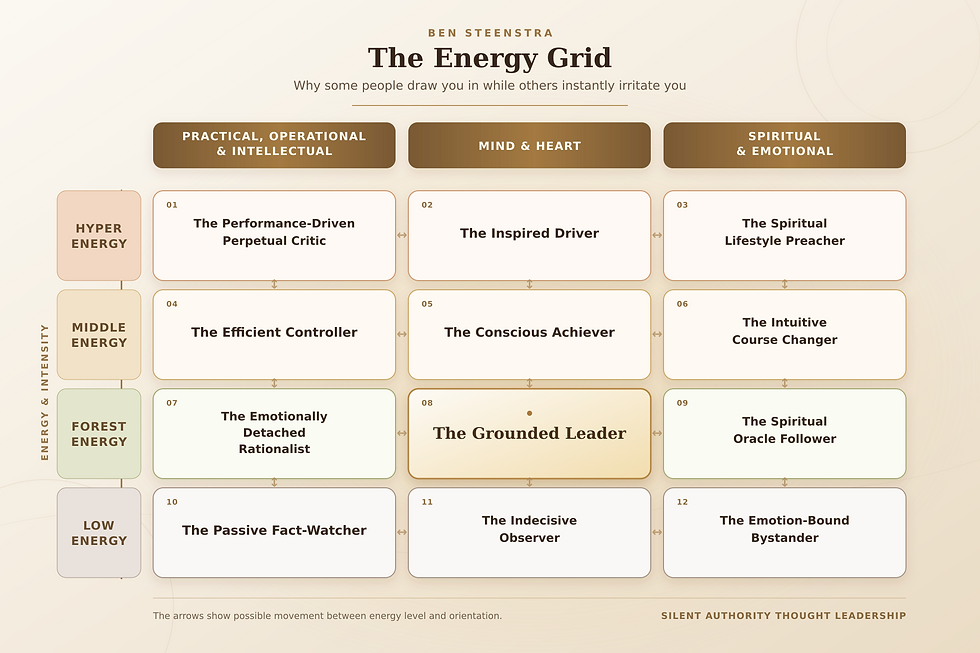
The Two Axes of the Energy Grid
The grid consists of three vertical columns and four horizontal energy levels. Together, they create twelve positions.
The Vertical Axis: Energy and Intensity
The vertical axis shows how much speed, tension, drive, stimulation or withdrawal someone brings.
From top to bottom, the grid distinguishes:
Hyper Energy
Middle Energy
Forest Energy
Low Energy
Higher does not automatically mean better.
A great deal of energy can inspire, persuade and create movement. That same energy can also dominate, exhaust or place everything under pressure. Low energy can create room for reflection and calm, but it can also lead to passivity, avoidance and indecision.
Forest Energy represents a calm, steadying form of energy. It is neither withdrawn nor rushed. There is room to observe, listen and respond without an immediate need to control.
The Horizontal Axis: What Do You Trust?
The horizontal axis concerns the way someone interprets reality and makes decisions.
The three orientations are:
practical, operational and intellectual;
mind and heart;
spiritual and emotional.
This distinction is not a value judgement either.
A practical and intellectual orientation can provide clarity, evidence and feasibility. Mind and heart combine reason, meaning and humanity. A spiritual and emotional orientation can create space for intuition and for information that cannot immediately be expressed in numbers or arguments.
Every orientation also carries a risk.
Facts can be used to exclude feelings. Mind and heart can produce so many perspectives that making a decision becomes increasingly difficult. Emotion and spirituality can help someone perceive something, but they can also be used to avoid responsibility or an uncomfortable reality.
You Are Not a Position. You Occupy a Position
The Energy Grid becomes superficial as soon as we say, “You are simply an Efficient Controller,” or, “She is just a Spiritual Oracle Follower.”
That is not how it works.
Someone may be a Conscious Achiever at work, become an Efficient Controller at home and move into the position of the Indecisive Observer during a personal crisis.
The position from which you act is influenced by factors including:
safety or threat;
responsibility;
sleep and fatigue;
success or loss;
falling in love;
uncertainty;
power;
conflict;
group pressure;
the energy and behaviour of other people.
A leader who normally listens calmly may begin to exert more and more control under financial pressure. Someone who usually decides quickly may, after a painful failure, turn into a Passive Fact-Watcher who demands complete certainty before taking another step.
Conversely, someone who was indecisive for a long time may, through experience, confidence and responsibility, increasingly begin to act as a Conscious Achiever.
The grid does not tell you definitively who you are. It shows the position from which you are acting at this moment.
The Twelve Positions in the Energy Grid
The twelve positions describe combinations of energy level and orientation. Each position contains both a quality and a risk. That combination is precisely what matters. A characteristic that is valuable in one situation can become completely excessive in another.
Hyper Energy: When Intensity Starts to Define the Room
1. The Performance-Driven Perpetual Critic
The Performance-Driven Perpetual Critic constantly sees what could be better, faster, sharper or more professional.
This person can accomplish an extraordinary amount. High standards, speed and analytical acuity can take a team or company to a level it would never have reached without that intensity.
The problem begins when good is never good enough.
Every result is then immediately followed by a new shortcoming. People receive less and less recognition for what they have achieved and more and more instructions about what is still wrong. Even compliments can begin to feel like the brief silence before the next correction.
The strength is ambition and sharpness.
The risk is an environment in which people no longer try to create something exceptional. They mainly try not to make a mistake.
2. The Inspired Driver
The Inspired Driver combines high energy with conviction, emotion and a powerful inner mission.
This is someone who can draw others into an idea. Their inspiration is palpable, and their willingness to persevere can turn something that initially seemed impossible into reality.
But inspiration does not protect anyone against tunnel vision.
When conviction becomes too strong, doubt, boundaries and fatigue may be treated as a lack of commitment. The mission then becomes more important than the people who have to carry it out.
The strength is movement driven by meaning.
The risk is that inspiration turns into relentless pressure, and anyone who slows down is seen as an obstacle.
3. The Spiritual Lifestyle Preacher
The Spiritual Lifestyle Preacher brings a great deal of emotional or spiritual energy and actively wants to involve others in it.
This person can open up new perspectives. They can help people look beyond productivity, evidence and what is immediately visible.
The risk emerges when a personal conviction is presented as a universal truth.
Anyone who makes a different choice is then no longer simply someone with another perspective, but someone who is not conscious enough, lives in fear or is failing to listen properly to the universe.
The strength is inspiration.
The risk is spiritual superiority, in which a conviction no longer invites examination but dictates how another person should live.
Middle Energy: When Action and Influence Take Centre Stage
4. The Efficient Controller
The Efficient Controller is practical, organised and results-oriented. This person wants to know what is happening, who is responsible for what and when it will be finished.
In organisations, this is often the person who prevents good intentions from ending in chaos. Agreements are followed up, processes are monitored and ambiguity quickly becomes visible.
But control can gradually take the place of trust.
At that point, it is no longer only the result that is monitored, but every intermediate step as well. People take less initiative because they know the controller will eventually revise the solution anyway. The system continues to function, but fewer and fewer people feel genuine ownership.
The strength is reliability and execution.
The risk is that the desire to maintain control destroys the very independence an organisation needs.
5. The Conscious Achiever
The Conscious Achiever wants to accomplish something while also taking people, meaning and consequences into account.
This person can reflect without becoming trapped in reflection. There is room for emotion, but also for what reality concretely requires. Decisions do not have to be emotionless in order to be clear.
The Conscious Achiever often takes a great deal of responsibility. That is also where the risk lies.
Because this person is accustomed to bringing mind, heart and execution together, they may unknowingly begin carrying other people's responsibilities as well. This is particularly likely when someone else radiates calm, freedom or sensitivity, qualities that can initially feel very attractive.
Later it may become apparent that the other person is not calm because they are grounded, but because they avoid difficult choices.
The strength is conscious action.
The risk is carrying too much, then becoming disappointed when the other person takes less responsibility than you initially believed.
6. The Intuitive Course Changer
The Intuitive Course Changer quickly senses where possibilities, tension or new energy are emerging.
This person can release what no longer works and sometimes sees sooner than others that an existing course has lost its power. That makes them flexible, creative and responsive to change.
The risk is that every new impulse becomes a new direction.
A plan is then never given enough time to prove itself. Adversity is interpreted as a sign that the chosen path is wrong. Energy repeatedly flows into the beginning of something new, but rarely into the dull, necessary work through which an idea becomes reality.
The strength is flexibility.
The risk is aimlessness that continues to feel like intuition from the inside.
Forest Energy: When Calm Becomes the Ground Tone
7. The Emotionally Detached Rationalist
The Emotionally Detached Rationalist often appears calm, stable and sensible. This person is not easily thrown visibly off balance and tries to approach problems logically.
That can be particularly valuable when others are being swept along by emotion. The rationalist can maintain perspective, distinguish facts and prevent every feeling from immediately becoming a decision.
But there is a difference between being calm and becoming emotionally unavailable.
When feelings are treated only as noise, other people may feel unseen. Not because the rationalist understands nothing, but because every emotional signal is immediately analysed, solved or put into perspective.
The strength is rational calm.
The risk is a form of calm in which genuine contact becomes increasingly difficult.
8. The Grounded Leader
The Grounded Leader combines calm, emotion, realism and responsibility.
This person does not need to control a room in order to influence it. They can listen without immediately giving way, tolerate tension without becoming hard and make a decision without pretending that every doubt has disappeared.
Their calm does not come from distance, passivity or the avoidance of discomfort. It comes from the ability to remain present while reality becomes complicated.
This connects directly with what I describe in Natural Authority: Why Some People Change a Room Before They Say a Word. Natural authority is shaped not only by what someone says, but also by what changes in a room when that person is present.
Yet the Grounded Leader is not a perfect human being either.
The risk sometimes lies less in the position itself than in what others project onto it. Calm is easily mistaken for wisdom. Self-control for certainty. A pleasant presence for moral reliability.
The Grounded Leader is an integrated position, but not a final destination and certainly no guarantee that someone is always right.
9. The Spiritual Oracle Follower
The Spiritual Oracle Follower often appears gentle, intuitive, receptive and calm.
That can be attractive, particularly to people who carry responsibility constantly and are used to analysing or organising everything. In this person's presence, life seems less burdensome for a while. Not everything has to be controlled. Not every choice needs to be made immediately. This connects directly with natural authority and the influence of presence.
But that calm may have a different origin from the one you assume.
The Spiritual Oracle Follower allows decisions to depend heavily on signs, readings, tarot, impulses, dreams or the energetically right moment. Feeling is no longer an important source of information alongside reality. It becomes the condition reality must satisfy before action can be taken.
The strength is receptiveness.
The risk is a loss of personal agency and the transfer of responsibility to something outside oneself.
This is precisely why someone can feel right immediately yet still not be right for you. Their calm, sensitivity and openness may be genuine, while the groundedness and responsibility you associated with those qualities were largely your own interpretation.
Low Energy: When Movement Becomes Increasingly Difficult
10. The Passive Fact-Watcher
The Passive Fact-Watcher first wants enough information, evidence and certainty before taking action.
There is valuable care in that. This person is not easily carried away by enthusiasm, group pressure or an appealing story without evidence.
But complete certainty rarely exists.
When more and more information is required, care can turn into an intellectually respectable form of delay. There is always another report, analysis, risk or unknown factor that must be examined first.
The strength is critical thinking.
The risk is that facts are no longer used to make a better decision, but to avoid making any decision at all.
11. The Indecisive Observer
The Indecisive Observer can understand different perspectives and often sees why every choice has both advantages and disadvantages.
That capacity for nuance is valuable. This person does not rush to a conclusion and can genuinely appreciate conflicting interests.
The problem begins when every new perspective reopens the decision.
Understanding then becomes a safe place from which life is observed. The observer can explain precisely why a situation is complicated but does not take responsibility for the inevitable incompleteness of every choice.
The strength is nuance and reflection.
The risk is that life is understood in great detail but barely lived.
12. The Emotion-Bound Bystander
The Emotion-Bound Bystander experiences feelings intensely, but is also constrained by them.
This person wants to act only when their inner state feels good enough. There must be calm, certainty, motivation, inspiration or a sense that the choice is completely right.
As a result, life can become increasingly small.
A difficult conversation is postponed because it still feels unsafe. A decision is not made because doubt remains. An opportunity is not taken because self-confidence is missing.
The strength is emotional sensitivity.
The risk is that feeling no longer provides information about a situation, but determines whether someone is allowed to move at all.
Why Are Certain Positions Attracted to One Another?
We are not attracted only to people who resemble us. Sometimes someone attracts us because they embody something we lack, suppress or temporarily need.
Four forms of attraction play an important role here.
Recognition
Someone occupies a position close to your own. Their pace, language and worldview feel familiar.
Two Conscious Achievers, for example, quickly understand why a decision needs to be both humane and workable. Two Efficient Controllers appreciate each other's clarity and punctuality.
That recognition can feel comfortable, but it can also reinforce shared blind spots.
Complementarity
The other person brings something you have developed less strongly.
A rational person may be attracted to someone who connects with emotion more easily. A hurried entrepreneur may relax deeply in the presence of someone with Forest Energy. An Indecisive Observer may admire someone who simply chooses a direction.
Complementarity can lead to growth, but also to dependence. This is especially true when you expect the other person to keep compensating for something you refuse to develop in yourself.
Relief
Some people temporarily take a burden from you.
A Conscious Achiever who constantly carries responsibility may feel liberated by someone who lives more lightly and intuitively. A controller may enjoy being around someone who barely plans. An introverted observer may allow themselves to be carried along by an Inspired Driver.
But what first provides relief may later cause irritation.
The lightness that helped you relax may begin to feel irresponsible when something has to be carried together. The decisiveness that helped you move may feel like dominance as soon as you want to choose another direction yourself.
Projection
Sometimes we see one quality and fill in the rest ourselves.
Someone radiates calm, so we assume they must also be grounded. Someone speaks passionately, so we believe the content must be sound. Someone is sensitive, so we presume that they are also empathetic and responsible.
But a quality never comes alone.
Sometimes we are not attracted to the whole person, but to what their energy temporarily resolves within us.
Why Can Attraction Later Turn into Irritation?
Attraction often develops before two people actually have to carry anything together.
During a first encounter, calm may be attractive. In a relationship, collaboration or business, that calm must also relate to responsibility, agreements, disappointment and conflict.
The same quality may then take on a different meaning:
calm becomes passivity;
flexibility becomes aimlessness;
decisiveness becomes dominance;
rationality becomes emotional distance;
sensitivity becomes indecision;
care becomes delay;
spirituality becomes avoidance of reality.
Imagine that a Conscious Achiever meets someone who feels like a Grounded Leader. The other person is calm, sensitive and appears free from the constant need to control everything.
That feels like relief.
Only later does it become clear that important decisions are postponed until a reading, sign or intuitive moment provides sufficient certainty. What initially felt like groundedness turns out to be closer to the position of the Spiritual Oracle Follower.
The calm was not false.
Only the conclusion that this calm also meant independence, realism and responsibility was premature.
Attunement can arise immediately. Compatibility becomes visible only when different positions have to carry something together.
Why Do Some People Irritate You Instantly?
Not every irritation means the other person is doing something wrong. Sometimes someone genuinely conflicts with your values or boundaries. At other times, that person mainly makes visible something that was already under tension within you.
Irritation can arise from different sources.
A Difference in Pace
Someone with Hyper Energy may experience Low Energy as slow, unmotivated or passive. Someone with Low Energy may experience Hyper Energy as forceful, loud and exhausting.
Both are observing behaviour that is genuinely present, but they interpret it from their own position.
A Difference in Orientation
A strongly rational person may find an emotionally oriented person elusive. The emotionally oriented person may experience the same rationalist as cold, limited or insensitive.
The irritation comes not only from what someone does, but also from the fact that both people treat different kinds of information as real and relevant.
An Exaggerated Version of Yourself
A quality you try to control in yourself can become extraordinarily irritating when someone else displays it without restraint.
Perhaps you have taught yourself never to be dominant and therefore react disproportionately to an Inspired Driver. Perhaps you suppress your own need for control, and an Efficient Controller touches precisely the part of yourself you do not want to recognise.
A Threat to Your Position
Some people irritate us because their presence makes our own position feel less self-evident. That is also what our irritation can reveal about ourselves.
Someone who remains calm may unintentionally expose another person's agitation. Someone who does make a decision can be confronting to someone who continues to observe. Someone who names a clear fact can disrupt the reassuring interpretation in which another person felt safe.
The other person does not always create something new. Sometimes they merely reveal what was already under tension within you.
How Do People Move Through the Energy Grid?
The arrows in the Energy Grid show that positions are not fixed. Movement can occur both vertically and horizontally.
Vertical Movement
In vertical movement, the main orientation remains roughly the same, but the energy level changes.
A Conscious Achiever may become an Inspired Driver under pressure. The desire to act responsibly remains, but intensity rises and listening increasingly gives way to pushing.
Through experience and inner calm, that same Conscious Achiever may begin to act more like a Grounded Leader. The sense of responsibility remains, but the need to keep creating movement diminishes.
During prolonged exhaustion, movement may continue towards the Indecisive Observer. The person still sees multiple perspectives but lacks the energy to turn them into a choice.
Horizontal Movement
In horizontal movement, the energy level remains roughly the same, but the way someone processes information and makes decisions changes.
An Efficient Controller may allow in more emotion and humanity, moving towards the Conscious Achiever.
A Conscious Achiever may begin to rely more heavily on impulses and become an Intuitive Course Changer.
A Grounded Leader may close off emotionally under pressure and shift towards the Emotionally Detached Rationalist. The calm remains visible, but genuine contact disappears.
The same Grounded Leader may also move in the other direction and increasingly surrender personal agency to signs, predictions or spiritual authorities. That produces movement towards the Spiritual Oracle Follower.
No movement automatically proves growth or decline. More energy is not always better. Less energy is not always worse. And a position in the middle is not inherently healthier.
The essential question is:
Does this position fit what reality is asking of you now, without causing you to lose contact with yourself or with that reality?
What Happens When Two Positions Reinforce One Another?
People do not bring only their own position. They also influence the position of the other person.
A Grounded Leader can help an Inspired Driver slow down without breaking their inspiration. One person's calm does not have to extinguish the other's energy. It can give that energy direction.
A Conscious Achiever can help an Indecisive Observer turn insights into choices. Not by removing all nuance, but by accepting that a decision will never eliminate every uncertainty.
Other combinations reinforce each other's risks instead.
A Performance-Driven Perpetual Critic and an Efficient Controller can be extraordinarily productive together. At the same time, they may create an organisation in which people feel constantly monitored and judged.
An Intuitive Course Changer and a Spiritual Oracle Follower can completely affirm one another's feelings and impulses while neither takes responsibility for execution and consequences.
A Passive Fact-Watcher and an Indecisive Observer can analyse every problem in great depth together without ever deciding what must happen tomorrow.
No combination is inherently right or wrong. The question is what two people activate in one another, and whether they can also correct one another when their qualities become excessive.
The Energy Grid in Leadership and Collaboration
Leaders do not influence others only through their decisions and words. The position from which they act also shapes what develops within an organisation.
The Performance-Driven Perpetual Critic can bring sharpness and quality, but may also create psychological insecurity.
The Efficient Controller can establish structure, but may remove initiative and ownership from a team.
The Inspired Driver can motivate people to rise above themselves, but may also ignore signs of overload.
The Indecisive Observer can understand complexity exceptionally well, but may leave employees without direction.
The Grounded Leader can hold tension without immediately reaching for control, distance or spiritual explanations. This is closely related to Gentle Leadership, which combines calm and empathy with clear boundaries and responsibility.
Natural authority therefore does not arise because someone is always calm. It arises because someone can remain present, reality-oriented and responsible under changing circumstances.
That is also why leadership development is not only about learning new skills. A leader can learn the perfect wording for giving feedback and still act from irritation, fear or control.
The technique may sound correct. The position behind it remains perceptible.
How Do You Recognise Your Own Position?
The Energy Grid is not intended to help you choose a quick label. The more interesting question is how your position changes when circumstances change.
Ask yourself:
What happens to my energy when I am under pressure?
Do I push harder, exert more control or begin to delay?
Do I rely mainly on facts, on mind and heart, or almost entirely on feeling?
Which position do I usually occupy during conflict?
Which people do I find instantly attractive?
Who irritates me without any clear reason?
Whose responsibility do I take over too quickly?
What disappears from me when I adapt to someone else?
From which position do I make my best decisions?
What movement do I make when I am tired, afraid, successful or in love?
Which position do I occupy when nobody contradicts me?
Can other people still reach me when I am convinced that I am right?
The intention is not to analyse every conversation constantly. The grid would then become another form of control.
The purpose is to recognise a little sooner what would otherwise remain invisible.
Do Not Use the Energy Grid to Confine People
Every model loses its value as soon as it becomes more important than the person it is trying to understand.
“You are a Spiritual Oracle Follower” traps someone inside a conclusion.
“In this situation, you seem to be acting mainly from that position” leaves room for circumstances, development and conversation.
That difference is essential.
People change. They respond to one another. Someone can be extraordinarily grounded in one part of life and avoid every form of responsibility in another.
Do not use the Energy Grid to prove that you are right about someone. Use it to ask better questions.
What makes this position attractive or necessary at this moment? Which strength is someone trying to protect? Where has that strength become excessive? And what might help them move again?
A label closes something down. A good question makes movement possible.
Do Not Merely Feel What Someone Does to You
Your first feeling about someone is not worthless. You often perceive something before you understand precisely what it is.
But a first feeling is not yet a complete judgement.
Not every form of calm has the same origin. Not every form of decisiveness has the same quality. Sensitivity does not always mean empathy. Rationality does not always mean wisdom. And not everything that immediately feels right will continue to feel right once life becomes concrete.
Some people attract you because they truly suit you. Others because they temporarily quiet something within you. Some people irritate you because their behaviour conflicts with your values. Others because they reveal something you would rather not encounter in yourself.
You do not have to distrust your first feeling.
But the better you understand the position from which you are meeting one another, the more clearly you can see what that feeling is actually trying to tell you.
Frequently Asked Questions About the Energy Grid
What Is the Energy Grid?
Ben Steenstra's Energy Grid is a model containing twelve positions based on energy level, intensity and the relationship between practical thinking, mind and heart, and spiritual or emotional perception. The model helps people recognise patterns in presence, behaviour, attraction, irritation and collaboration more clearly.
Why Do You Feel Instantly Attracted to Certain People?
Someone may feel familiar because their pace, attention and way of perceiving the world align with your own position. Attraction can also arise because the other person temporarily brings something you lack, such as calm, decisiveness, freedom, structure or sensitivity.
Why Can Attraction Later Turn into Irritation?
A quality may be attractive during a first encounter but take on another meaning in everyday life. Calm may prove to be passivity, decisiveness may become control and sensitivity may lead to indecision. Compatibility becomes truly visible only when people have to carry responsibility, tension and disappointment together.
Why Do Some People Irritate You Instantly?
Immediate irritation may arise from a difference in pace, intensity or orientation. The other person's behaviour may also reveal a quality you try to suppress in yourself, or threaten a position in which you feel safe.
Can Someone Move from One Position to Another?
Yes. The twelve positions are not fixed personality types. Pressure, safety, responsibility, fatigue, loss, success, relationships and personal development can all cause someone to move vertically or horizontally through the Energy Grid.
Which Position in the Energy Grid Is Best?
No position automatically makes someone better than another person. The Grounded Leader combines many qualities, including calm, emotion, realism and responsibility, but this position is neither permanent nor perfect. The more important question is whether a position fits what the situation requires.
What Does Forest Energy Mean?
In the Energy Grid, Forest Energy represents a calm, steadying form of presence. It involves less agitation than Hyper or Middle Energy, but more availability and movement than Low Energy. That calm may be grounded and connecting, but it can also be rationally detached or dependent on spiritual explanations.
Is the Energy Grid Scientifically Validated?
The Energy Grid is Ben Steenstra's own observation and reflection model. It is not a scientifically validated personality test and makes no claims about literally measurable personal frequencies. The model is intended to make conversations about behaviour, presence and interpersonal dynamics more concrete.
How Can You Use the Energy Grid in Leadership?
The grid helps leaders recognise the energy they bring into a team, how they change under pressure and what their presence activates in others. It can reveal, for example, when decisiveness turns into pressure, structure into control or reflection into indecision. It also provides a practical lens for developing influence through Silent Authority, because influence begins with the position from which a leader acts.
Can You Use the Energy Grid in Relationships?
Yes. The model can help explain why someone immediately feels familiar or attractive, why the same qualities later cause irritation and which positions partners reinforce in one another. It should never be used as a diagnosis or a definitive judgement of another person.


Comments