


Why Specialized AI Has the Future and Generic AI Is Often Not Enough

Updated: Jul 3
AI is everywhere. In presentations, news articles, tools, demos, and promises. Most of the conversation is about speed, efficiency, and scale. About everything AI can automate. About how smart it sounds. About how quickly it gives an answer.
But that is not the question that interests me most.

The question that really matters is much more concrete: when does AI become genuinely useful for a person who needs clarity, direction, or sharper thinking?
Because that is where the difference begins between technology that impresses and technology that truly adds value.
Most AI is impressive, but far from always truly useful
Generic AI tools are now strong enough to support many tasks very well. For brainstorming, summaries, first drafts, and quick structure, they are often excellent. But the moment a conversation really needs to be about something meaningful, you start to notice the limit.
That is when it becomes clear that breadth is not always the same as depth.
Why generic AI often falls just short
One of the biggest misunderstandings around AI is that people confuse fluency with quality.
If an answer comes quickly, sounds logical, and is well worded, it easily feels intelligent. Sometimes it is. But often it is mainly probable. A language model looks for patterns, relationships, and the most likely continuation in language. It does not automatically search for what is most accurate, wise, or useful in your specific situation.
That difference may seem small, but it is significant.
Smart phrasing is not the same as strong substance
For general questions, that is usually not a problem. For concrete business questions, positioning, pitches, leadership dilemmas, or difficult conversations, it becomes much more relevant. In those moments, you do not want an answer that merely sounds polished. You want something that is grounded in something real.
Breadth has a price
The more general an AI system is, the greater the chance that the answer will be reasonably good, but not sharp enough. You often get something that looks useful, but remains too safe, too smooth, or too generic.
You see this especially in moments where nuance, experience, and sensitivity to language make the difference, such as:
sharpening a proposition
preparing for a difficult conversation
improving a pitch or presentation
organizing strategic doubt
reducing noise to a clear core
At those moments, a system that has an opinion on everything is of limited value. What helps more is a system that was truly built for something specific.
The future of AI is specialized
I believe the next interesting step in AI does not lie in even more general systems, but in specialized AI.
Not AI that gives a reasonable answer on every subject, but AI that fits better, responds more sharply, and is more relevant within a clearly defined domain.
That requires a different way of building.
Not just a strong model, but also:
clear content boundaries
a serious knowledge base
practical experience as a source
a recognizable tone and personality
concrete moments of use
clear limits in what the system should and should not do
That is where something new emerges. Not an artificial human. Not a digital magic trick. But a form of AI that makes human expertise more carefully accessible.
Why expertise is more than information
What makes a good strategist, executive coach, or advisor valuable rarely lies in knowledge alone. The real value often lies in the way someone sees.
Can you spot the difference between symptom and root cause?Can you hear where the language is still off? Can you recognize when someone is speaking about content but avoiding the real issue? Can you sense when a story looks right on paper but will not land in practice?
That kind of distinction does not emerge from information alone. It comes from experience, from mistakes, from real-world practice, and from years of refining how you listen, weigh, and sharpen.
And that is exactly why I believe specialized AI only becomes interesting when it is fed with more than isolated input. It needs to be built on a coherent whole of knowledge, practice, perspective, and boundaries.
An expert does not just give answers, but sees patterns
When specialized AI becomes truly valuable
Ultimately, the question is not whether AI sounds smart enough. The question is whether it helps at a moment when something is actually at stake.
For example, when someone wants to:
sharpen a business idea
refine a positioning strategy
practice a pitch
stop postponing a difficult conversation
find clarity in the overlap between work, pressure, and private life
These are not minor moments. These are exactly the situations in which people spend too long doubting, postponing, or overthinking. Not because they are incapable, but because they are too close to their own question.
That is where specialized AI can become relevant. Not as a replacement for a human in every case, but as a direct conversation partner that helps people move more quickly toward language, distinction, and action.
Why conversational AI and a realistic avatar can sometimes make perfect sense
A lot of nonsense is being sold around avatars and AI personas. Often the visual effect matters more than the substance. What remains is mostly a demo.
Still, that does not mean the form is empty by definition.
Some interactions work better in conversation than in text. Practicing a pitch out loud is different from typing a prompt. Preparing for a difficult conversation becomes more concrete once you say it out loud. You hear a speech better than you read it. People often formulate more honestly and directly when they speak.
In that case, a conversational interface or realistic avatar is not a gimmick, but a functional choice.
Not because it looks technologically impressive. But because it supports a moment of use more effectively.
What AI Ben means to me
It is from that perspective that I started developing AI Ben.
Not as a general chatbot. Not as a trick. Not as a marketing layer on top of existing AI. But as an exploration of a more serious question: can you translate accumulated human expertise, language, experience, and a way of seeing into a specialized AI conversation partner in a way that becomes practically valuable?
That is the core.
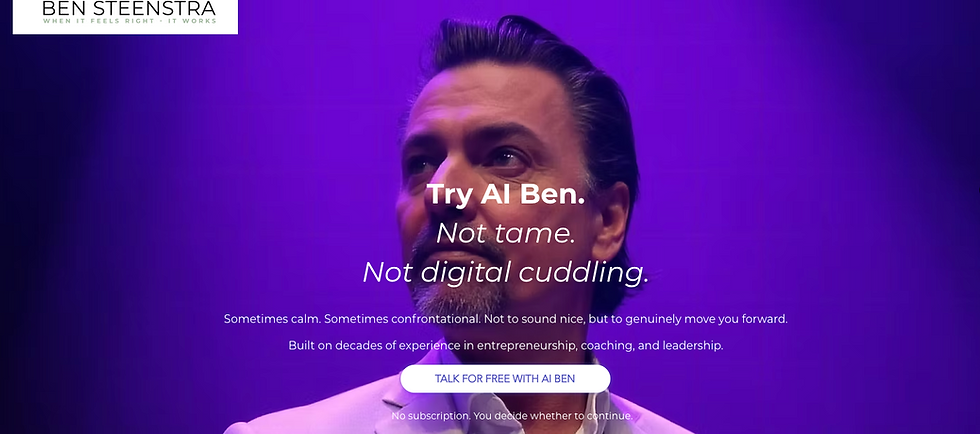
AI Ben becomes interesting to me when it helps in moments of real friction. Not in casual output, but in situations where someone needs to express something, prepare something, sharpen something, or face something.
Think of an entrepreneur whose proposition is still not sharp enough. A leader who has to handle a difficult conversation. A professional with a pitch that is solid in substance but does not land. Or someone looking for clarity when strategy, pressure, and personal noise are all mixed together.
That is where I see the real potential of AI.
Why specialized AI is more credible than an all-knowing system
One of the biggest weaknesses of many AI systems is that they want to answer almost everything. That sounds powerful, but it often makes them less reliable.
A system becomes more credible when it is clear what it is good at and what it is not.
That is why I believe far more in specialized AI with clear boundaries than in systems that know a little about everything. Limitation is not a weakness. It is a form of quality discipline.
Boundaries make a system stronger
As soon as an AI system has a defined domain, a recognizable source, and a clear intention, it becomes more useful. Not perfect. Not infallible. But more relevant.
The mature way to look at AI
The discussion around AI is often made too big or too simplistic. It immediately becomes about replacement, threat, or total disruption.
I think the most interesting development is much more concrete.
Not: does AI replace the expert? But: can AI make certain forms of expertise more accessible at moments when otherwise nothing would happen?
For a long time, there was an empty space between opening a general AI tool and booking a session with an expert. That is exactly where something new is now emerging.
Specialized AI can become that middle layer. A form of direct access to language, sharpness, structure, and reflection, without pretending to replace the full human relationship.
To me, that is a far more realistic and far more valuable perspective.
Conclusion: the real future of AI is not broader, but more relevant
The future of AI will not be decided by whoever makes the biggest claims. Nor by whoever builds the most spectacular demo.
The real value will emerge in systems that are genuinely built for something. Systems with substance. With practice. With boundaries. With personality. With limits. With a clear role in the real lives of people. That also requires staying honest about the possibilities and dangers of AI.
Not more generic output. But better, more relevant interaction.Not AI that tries to be everything.But AI that truly helps at the right moments.
That, to me, is the direction in which AI becomes interesting. And mature.


Comments