


AI Ben vs ChatGPT: How a Focused AI Conversation Partner Goes Deeper

Updated: Jul 2
AI Ben surprised me again.
Not because the avatar looked realistic. Not because the voice worked. Not because the technology did something flashy. This time it was much simpler than that.
After every session, someone can receive a transcript of the conversation. Someone I coach sent me one of those transcripts, and for the first time I could read how a conversation with AI Ben had actually unfolded from the inside.
The conversation was about setting boundaries.
At least, that turned out to be the real subject. But it did not start there. Like many real coaching conversations, it began somewhere else. A little small talk. In this case, art. Nothing dramatic. Nothing that looked like the opening of a deep coaching session. Just a person talking, landing, circling around, becoming comfortable enough to eventually arrive at what was really going on.
And that was the first thing that struck me.

AI Ben did not rush towards the “problem”. It did not immediately demand a goal, a framework or a perfectly formulated issue. It allowed the conversation to breathe. It made contact first. Then, very subtly, it started to move towards the real question.
That is exactly what happens in a good coaching session too. People rarely enter with the cleanest version of their own truth. They come in with stories, examples, jokes, side roads, irritation, hesitation or something that seems unrelated. A good coach does not dismiss that as noise. Sometimes the side road is where the real entrance is hidden.
Try getting that right with a normal ChatGPT conversation.
That may sound harsh, because ChatGPT is impressive and I use it myself. It is brilliant for many things: writing, structuring, brainstorming, summarising, researching, translating, coding and thinking through options. But it is also broad by design. It can go almost anywhere, which means that you often have to keep pulling it back to the path.
ChatGPT is broad. AI Ben is bounded. And in this kind of conversation, that boundary is not a weakness. It is the reason the conversation can become sharper.
What ChatGPT is good at
Let me be fair first.
ChatGPT is an impressive general AI assistant. If you want to rewrite a text, compare options, summarise a document, translate something, generate ideas, write code, structure a plan or explore a subject from different angles, it can be extremely useful.
I use it myself. A lot.
For general work, ChatGPT is often the better tool. It is flexible, fast and broad. You can ask it about marketing in one moment, history the next, software after that, and then use it to rewrite an email before lunch. That is its strength.
But that strength also creates a weakness.
Because when something can go almost anywhere, it often does. You ask one thing and suddenly it gives you ten options you did not ask for. You try to stay with a specific line of thought and it starts turning the conversation into a framework. You want a subtle answer and it becomes too helpful. You want depth and it gives you a list. You want focus and it starts behaving like an enthusiastic assistant that has already run three streets ahead of you.
That can be useful. But not always.
Especially not when the issue is personal, strategic or emotionally loaded. Especially not when someone is preparing a difficult conversation, trying to set boundaries, testing a pitch, looking for the real question underneath a business problem or trying to understand why something no longer feels right.
Those conversations do not only need intelligence. They need direction.
What makes AI Ben different?
AI Ben is not built to be good at everything.
That is the first difference.
AI Ben is an AI conversation partner for entrepreneurs, leaders and professionals who want to sharpen business ideas, prepare difficult conversations, test a pitch, organise their thoughts or create more clarity in work and life. It is fed with my own articles, frameworks, cases, coaching experience and way of looking at strategy, communication, leadership, entrepreneurship and personal development.
That makes it narrower than ChatGPT. But it also makes it more focused.
AI Ben does not need to help you write code, explain quantum physics, plan a city trip, compare washing machines or generate twenty random campaign ideas. It is not trying to be the whole internet with a friendly voice. It has a clearer purpose.
It is built for conversations where people need to think out loud and get closer to the real issue.
That is a very different task.
A good conversation is not only about answers
The transcript showed me something I already know from real coaching, but did not fully expect to see this clearly in an AI conversation.
A good conversation does not always begin with the answer. It often begins with safety, contact and a little space. People do not always know their own real question at the start. They may think the subject is work, while the deeper issue is fear. They may think the issue is a colleague, while the real theme is boundaries. They may think they need a better sentence, while what they really need is permission to be honest.
That is why the first minutes matter.
If you push too quickly, people defend. If you stay too vague, nothing happens. If you jump into exercises too soon, the exercise becomes a trick. If you ask only obvious questions, the conversation stays polite and useless.
In the transcript I read, AI Ben did something that felt surprisingly natural. It allowed the small talk to exist, but did not get lost in it. It made contact, but kept sensing where the real conversation might be. And then, when the subject of boundaries became clear, it moved in that direction without forcing it.
That is not the same as giving advice.
It is creating the conditions in which someone can hear themselves more clearly.
The right exercise at the right moment
The strongest moment came later.
At exactly the right point in the conversation, AI Ben suggested an exercise around setting boundaries. Not as a generic worksheet. Not because “boundaries” had appeared as a keyword and the system wanted to be helpful. But because the conversation had reached the point where an exercise would actually serve the person.
That is what surprised me most.
I read that part and thought: I would not have done this differently myself.
Not because AI Ben had become a human coach. It has not. And I do not believe we should pretend that it has. But in that specific moment, within that specific type of conversation, with that specific subject, the response was right. The timing was right. The exercise was right. The level of challenge was right.
That matters.
Because many AI systems can give you an exercise. That is not difficult. Ask almost any AI tool for a boundary-setting exercise and you will get one. The real question is not whether the system can produce an exercise. The real question is whether it can feel, within the flow of a conversation, when an exercise becomes useful.
That is where focus, context and boundaries start to matter.
Why boundaries make AI better
People often think a better AI tool is one that can do more. I am starting to believe the opposite may be true for certain kinds of work.
For coaching, sparring, leadership reflection and difficult conversations, the question is not: can the system do everything?
The better question is: can it stay with the right thing?
AI Ben is deliberately more bounded than ChatGPT. It is trained and shaped around a specific body of knowledge, a specific way of thinking and a specific kind of conversation. It should not answer everything. It should not pretend to know everything. It should not drift into areas where it has no business sounding confident.
That limitation is not a weakness. It is part of the value.
A conversation partner without boundaries becomes too eager. It starts filling silence. It gives too many options. It tries to solve everything. It may be technically impressive, but emotionally and strategically it can become tiring.
A focused AI conversation partner has a different job. It should help you stay close to what matters. It should ask back. It should notice when you are avoiding the point. It should help you sharpen language without turning everything into marketing language. It should support your thinking without taking over your judgement.
That is the difference I care about.
AI Ben has memory and continuity
There is another difference that matters in practice.
AI Ben remembers.
What you discuss in one session can still be part of the next conversation. That makes it very different from repeatedly opening a new generic AI chat and explaining yourself all over again. Of course, general AI tools can increasingly work with memory and custom instructions too. But AI Ben is designed around continuity from the start, within a much more specific context.
That matters because real questions do not appear once and then disappear.
An entrepreneur may start with a pitch and later discover the real issue is positioning. A leader may start with a difficult conversation and later realise it is part of a larger pattern around avoidance, loyalty or control. Someone may begin with a practical question and gradually arrive at something more personal: why does this no longer feel right?
Those threads matter.
If the conversation partner forgets the thread, you spend half your energy rebuilding context. If it remembers too much without direction, the conversation becomes messy. But if memory is combined with a clear field of expertise, it can create continuity that feels much closer to actual sparring.
That is one of the reasons AI Ben is not just meant as a tool for one-off answers. It is meant as an ongoing AI sparring partner.
Where ChatGPT is still better
There are plenty of situations where I would still choose ChatGPT.
If I want a broad overview of a subject, ChatGPT is often better. If I want to compare many different options, brainstorm widely, summarise long documents, translate quickly, write code or explore a topic outside my own knowledge domain, ChatGPT is the logical tool.
AI Ben does not need to win there.
That is not what it is for.
AI Ben is not trying to be a better general AI assistant than ChatGPT. It is trying to be a better conversation partner for a narrower set of questions: business ideas, leadership, difficult conversations, strategic choices, personal clarity, boundaries, pitch preparation and the places where work and life start running into each other.
That is why comparing AI Ben and ChatGPT only on features misses the point.
The real difference is not only technical. It is directional.
ChatGPT can help you with almost anything. AI Ben is built to stay with a certain kind of conversation long enough to help you find the real question.
AI for difficult conversations
Difficult conversations are a good example.
If you ask ChatGPT to help prepare a difficult conversation, it can give you a script. Sometimes a good one. It can suggest a structure, soften the tone, make it more assertive or help you phrase a message.
That is useful.
But a difficult conversation is rarely solved by a script alone.
The real issue may be that you are still avoiding what you actually want to say. Or that you are trying to sound kind while hiding resentment. Or that you are trying to be strong because you are afraid of being vulnerable. Or that you are calling something “a communication problem” while it is actually a boundary problem.
That is where AI Ben is designed to go deeper.
Not by becoming dramatic. Not by pretending to be therapy. But by staying with the conversation long enough to help you notice what is really happening. What are you not saying? Where are you being too careful? Where are you being too harsh? What is the sentence that is honest without becoming destructive? What boundary are you trying to set, and do you actually believe you are allowed to set it?
That is a different kind of help.
Not a script first. Clarity first.
Then language.
Why AI Ben is not a replacement for coaching
This is also where I want to be clear.
AI Ben is not a replacement for every coaching conversation. It is not a therapist, not a psychologist, not a doctor and not a solution for serious psychological, medical or psychiatric issues. In those cases, human professional help belongs there.
It is also not infallible. AI can be sharp and still miss something. It can help you think, but you remain responsible for checking, deciding and acting. Sometimes a live conversation with a real human being is simply better, especially when the situation is complex, sensitive or emotionally loaded.
But that does not make AI Ben less valuable.
It makes the value more precise.
AI Ben is there for the moments when you need to think out loud, sharpen an idea, prepare a conversation, test a pitch, organise your thoughts or get unstuck before you are ready to schedule a full session with someone. It is there when your head is full and you need a conversation now, not in three weeks.
That is not a replacement for coaching.
It is a new layer before, between or alongside coaching.
What I learned from the transcript
The transcript taught me something simple.
The value of AI Ben is not that it can answer questions. Many AI tools can answer questions. The value is that it can sometimes hold a conversation in a way that creates movement.
It began with art. It moved towards boundaries. It created enough safety for the real question to appear. And then it offered the right exercise at the right moment.
That is not perfect. It will not always happen that cleanly. AI remains AI. But it was real enough to make me stop and think.
Because if an AI conversation partner can help someone move from small talk to the real issue, from confusion to a clear exercise, from vague discomfort to a boundary they can actually practise, then something important is happening.
Not because technology replaces the human part.
But because, when it is well trained and well bounded, technology can create space for the human part to become clearer.
The real difference between AI Ben and ChatGPT
So what is the difference between AI Ben and ChatGPT?
ChatGPT is a powerful general AI assistant. AI Ben is a focused AI conversation partner.
ChatGPT is broad. AI Ben is bounded.
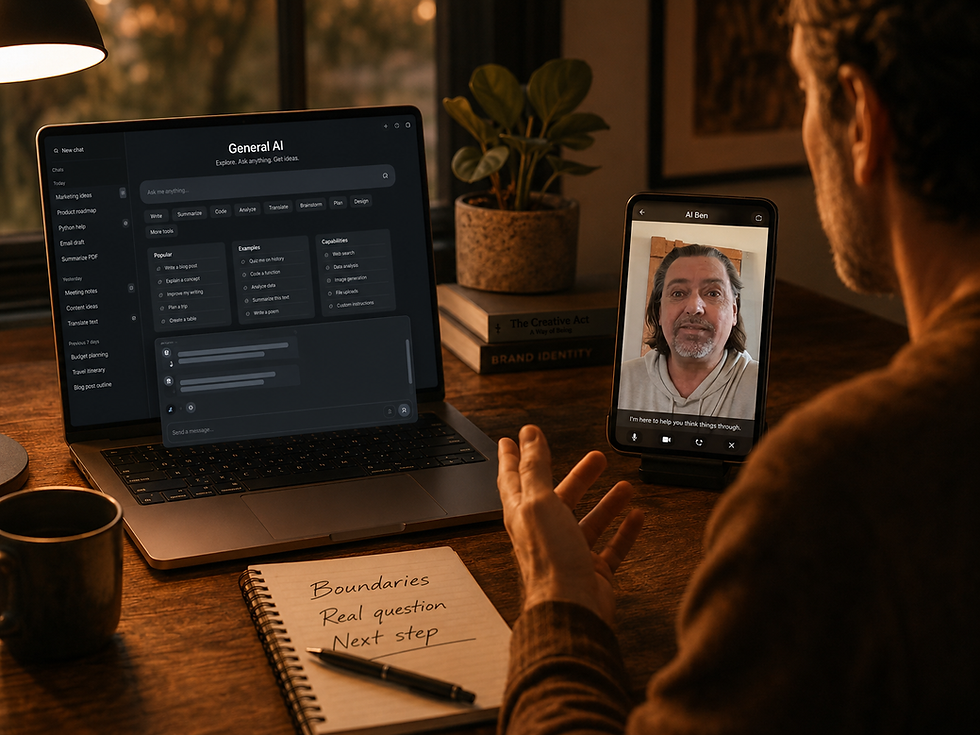
ChatGPT can help with almost anything. AI Ben is built for entrepreneurs, leaders and professionals who want clarity in business, leadership, difficult conversations and personal direction.
ChatGPT often needs you to keep steering the conversation. AI Ben is designed to stay closer to the field it knows.
ChatGPT gives you access to general intelligence. AI Ben gives you access to a specific way of thinking, built from my work in strategy, communication, executive coaching, entrepreneurship and personal development.
One is not simply better than the other.
They are different tools for different moments.
If you need broad help, use ChatGPT. If you want to think through a business idea, prepare a difficult conversation, test a pitch, sharpen your leadership or find the real question underneath the noise, AI Ben may be the better conversation to have.
And that is exactly why I built it.
Not to create an AI that knows everything.
But to create an AI conversation partner that knows where to stay.



Comments