


Why Speaking in Front of an Audience Is Not Just About Technique

Updated: Sep 15
An old classmate of mine, whom I will call Gerard for convenience, runs a very successful company. He is sharp, experienced and knows his field inside out. In one-on-one conversations, he can talk for hours. Ask him about his company, his market, his ideas or the lessons he has learned as a founder, and he comes alive.
But put him in front of a room and something changes.
His role as founder and leader regularly requires him to speak in front of an audience, sometimes to a small group, sometimes to a much larger one. And yet the mere thought of it gives him buckling knees. That may sound strange from the outside. How can someone who is clearly competent, successful and talkative suddenly become insecure when more people are watching?
But it is not strange at all.

I see this more often, especially with entrepreneurs, leaders and professionals who have a lot to say but do not enjoy becoming the center of attention. They may know the content. They may have experience. They may even be naturally expressive in normal conversations. But the moment there is an audience, something deeper is activated. Suddenly it is no longer just about speaking. It is about being seen.
That is why public speaking is not only a technical skill. Yes, you can learn structure, breathing, rhythm, eye contact and storytelling. All of that helps. But if you do not understand what is happening inside you when people look at you, technique will only take you so far.
Why Public Speaking Fear Is Often Not About Speaking
In my opinion, almost everyone can learn to speak in front of an audience. Not everyone will become a world-class speaker, and not everyone needs to. But most people can become clear, present and credible enough to speak in front of others without being taken over by fear.
The more interesting question is not whether you can learn to speak. The better question is: what do you believe will happen when you do?
For many people, the fear is not really about words. It is not even about forgetting a sentence or losing the structure of the talk. Underneath, there is often a belief that being seen is dangerous. That you may be judged. That you may not be good enough. That people may discover something about you. That your value depends on how well you perform.
Gerard himself said he lacked self-confidence. I understood what he meant, but I did not fully agree. In many cases, the problem is not simply a lack of confidence in the skill of speaking. It is connected to a lack of self-esteem, or more precisely, to the question whether you allow yourself to be visible, imperfect and still valuable in front of others.
That distinction matters.
If you think the problem is only self-confidence, you may try to solve it by learning more tricks. You take a course, memorize openings, practice gestures, copy speakers you admire and hope the fear disappears. Sometimes that helps. But if the deeper fear is about your worth, then tricks may even make you more tense, because now you are not only afraid of speaking badly. You are also afraid of failing to perform the tricks correctly.
Self-Confidence Versus Self-Esteem
Self-confidence and self-esteem are often used as if they mean the same thing, but they are not the same.
Self-confidence is about your belief in your ability to do something. It is task-related. You can be confident in one area and insecure in another. Someone can be very confident as a musician but insecure in sports. A founder can be confident in a board meeting but insecure on a stage. I may be confident writing, coaching or speaking about strategy, but please do not put me in a fighter jet and expect a good outcome.
Self-esteem goes deeper. It is about the value you place on yourself, independent of performance, status, applause or external approval. It is the inner sense that you are allowed to exist, to take up space, to be seen and to remain worthy even when something does not go perfectly.
That is why self-worth is so important in public speaking.
Self-confidence asks: can I do this?
Self-esteem asks: am I still okay if I do not do this perfectly?
That second question is often the real one.
When someone says, “I have no self-confidence,” that is rarely true in an absolute sense. The same person drives a car, writes emails, makes decisions, holds conversations, cooks, works, solves problems and manages daily life. There is clearly confidence in many abilities. What often collapses on stage is not every form of confidence. It is the feeling of being allowed to stand there without needing to prove your right to exist.
People with strong self-esteem are not fearless. They may still be nervous. They may still make mistakes. They may still need preparation. But they are less likely to interpret imperfection as personal failure. They can stand in front of a room and think: I may not do this perfectly, but I am still allowed to be here.
That changes everything.
Why Self-Esteem Matters More Than Perfect Performance
Self-esteem is not about thinking you are amazing at everything. It is not arrogance. It is not telling yourself you are brilliant when you are unprepared. It is a quieter and more stable form of self-respect.
Think of a child singing a song completely out of tune while proudly showing a colourful drawing. When the child asks, “Beautiful, isn’t it?”, a loving parent does not judge the child the way a professional jury would judge a singer or painter. The parent sees the joy, the openness, the innocence and the life in the child. The value is not in perfect performance. The value is in the being.
That is the feeling many adults lose.
Over time, we learn to judge ourselves. We learn that performance matters, that appearance matters, that approval matters, that mistakes can be embarrassing and that other people’s opinions can hurt. Some of that is useful. It keeps us from being careless. It makes us prepare. It helps us understand that not every impulse should be followed.
But if judgment takes over completely, we no longer speak from presence. We speak from self-protection.
That is why public speaking becomes so hard for many people. They are not only trying to deliver a message. They are trying to survive being judged. Every silence becomes dangerous. Every face in the audience becomes a possible verdict. Every forgotten word becomes proof that they should not be there.
Strong self-esteem does not remove all nerves. But it makes the nerves less important. You can be nervous and still speak. You can stumble and still continue. You can forget a sentence and still be worth listening to.
Authenticity Makes People Listen
There are countless techniques you can learn to speak more effectively. You can learn how to structure a talk, use pauses, open with a story, build tension, use your voice and close with impact. Those techniques are valuable. I use them myself and I teach them when needed.
But techniques alone do not make you authentic.
And in front of an audience, authenticity often determines whether people truly listen. A perfectly polished speaker who feels rehearsed, distant or artificial can be far less compelling than someone who occasionally searches for words but is clearly real.
This does not mean you should be sloppy. It does not mean preparation is unnecessary. It means your humanity should not disappear behind technique.
In public speaking, it is authenticity that often makes the difference. People can feel when you are trying to impress them. They can also feel when you are trying to reach them. Those are not the same thing.
When you are overly focused on how you come across, you become split in two. One part of you is speaking, while another part is watching yourself speak. Am I interesting enough? Am I doing this right? Are they bored? Do they like me? Do I look strange? Was that sentence stupid? Should I move more? Should I move less?
That inner monitoring makes you less present. You start managing yourself instead of connecting with the people in front of you.
A speaker with stronger self-esteem can still ask useful questions about the audience, but not from panic. They can ask: what do these people need to understand? What matters here? What story helps them feel the point? What can I give them that is real?
That shift from self-protection to contribution is one of the biggest changes in public speaking.
The Questions That Make Speaking Harder
When self-esteem is fragile, the mind starts producing questions that seem useful but often create more fear.
Am I interesting enough?
Am I saying the right things?
Am I coming across well?
Do they like me?
What if I make a mistake?
What do they think of my appearance?
Will they respect my opinion?
Do I know enough?
What if someone disagrees?
Am I really the right person to talk about this?
Aren’t others much better at this?
These questions are human. Almost every speaker knows them in some form. The point is not that you must never have them. The point is that they should not be in charge.
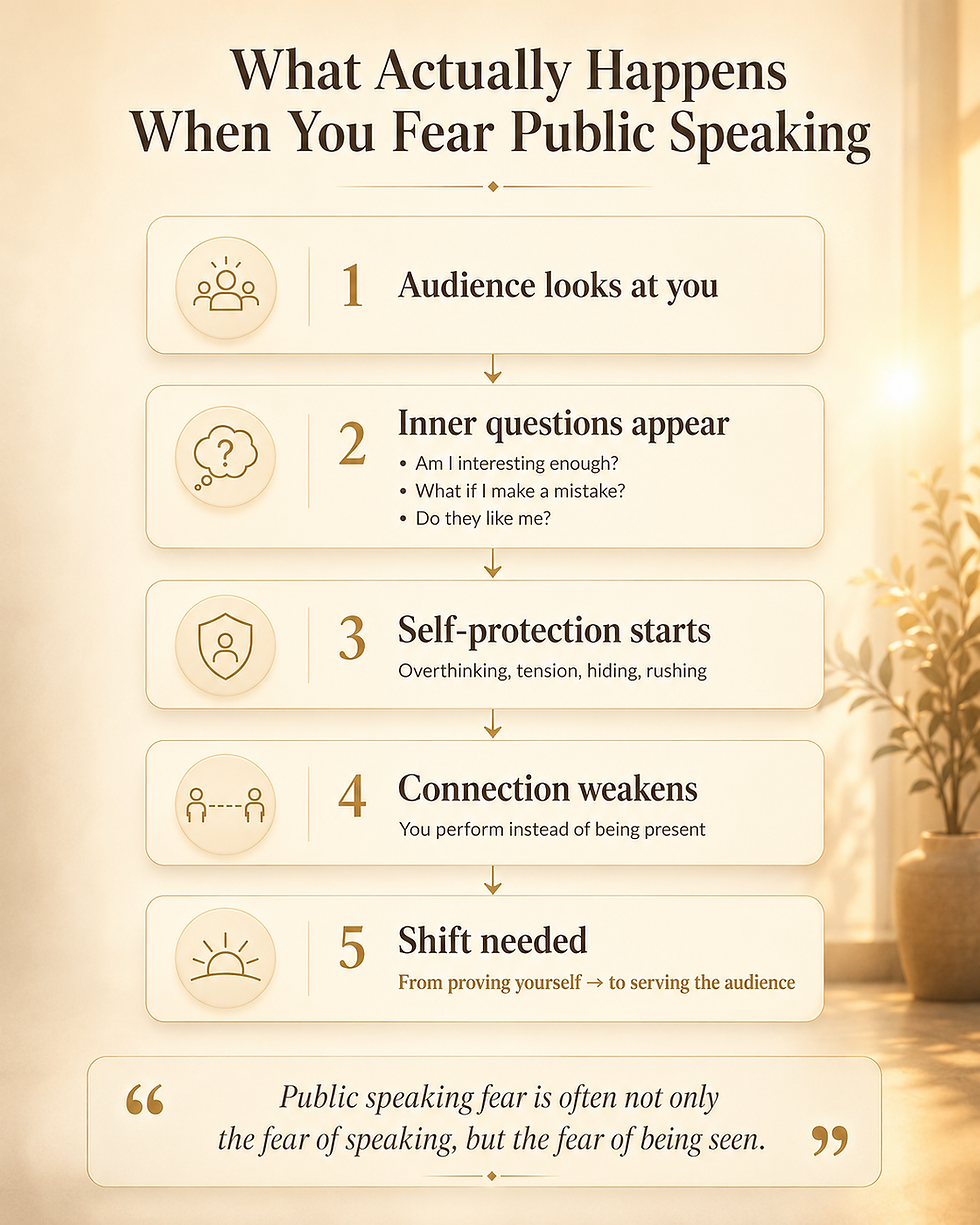
When self-esteem grows, the questions lose some of their power. They may still appear, but they no longer decide the whole experience. You can notice the fear without obeying it. You can prepare well without trying to become flawless. You can stand there as a human being instead of a product being evaluated.
That is why I do not believe public speaking should be reduced to presentation skills. It is also personal work. It asks you to relate differently to visibility, judgment and imperfection.
Vulnerability Can Make Your Message Stronger
When people think about strong public speakers, they often imagine individuals who speak with self-assurance and authority. That image is not wrong, but it is incomplete.
Some of the most powerful moments in public speaking are not the moments of flawless authority. They are moments of genuine vulnerability. A speaker admits uncertainty. Shares a personal lesson. Acknowledges the difficulty of the topic. Shows the human side behind the expertise.
That does not weaken the message. It can strengthen it.
People do not only connect with competence. They connect with truth. If someone stands in front of an audience pretending to be untouchable, the audience may admire them but stay at a distance. If someone shows enough humanity to be real without becoming self-indulgent, the audience often leans in.
Gerard could use his fear in exactly that way. Instead of hiding every trace of nervousness, he could begin by saying something simple and honest: “I have spoken about this subject one-on-one for years, but standing here in front of a room still makes me nervous. So if my voice needs a minute to catch up with my message, now you know why this topic matters to me.”
That kind of honesty can create trust. Not if it becomes a therapy session, but if it serves the message.
That distinction becomes especially important in a personal eulogy. Your grief may be visible, as long as it helps reveal the person and the relationship rather than making the audience responsible for carrying it.
In a farewell speech for an employee who is leaving, something similar applies: your disappointment may be felt, but it should not overshadow your appreciation of the other person.
Vulnerability is powerful when it opens connection and meaning. It becomes distracting only when the speaker makes the audience responsible for their insecurity.
The key is not to avoid weakness. The key is to know how to carry it.
Preparation Still Matters
There is one danger in talking about self-esteem and authenticity. People may start to think that if they just “be themselves,” preparation no longer matters.
That is a mistake.
Authenticity without preparation can become chaos. Self-esteem without preparation can become bravado. And I learned that lesson the hard way.
Years ago, an entrepreneur friend of mine, for whom I often wrote speeches and whom I coached in public speaking, was unable to attend an award ceremony where he had been invited to speak. Because I had also been involved in his campaigns as a strategist and marketer, he asked me to attend on his behalf.
Without real preparation, but with plenty of skills and self-esteem, I said yes.
There I stood, in a room filled with more than a hundred fellow professionals. Award after award was presented. To my discomfort, our company was passed over. Still, I was expected to give a ten-minute speech. In the fifteen minutes before I had to speak, I wondered what on earth I could say after we had not won anything.
That was the moment I realized I should have prepared.
Instead, I decided to lean on technique, experience and bravado. That turned out to be a mistake. I took the floor with far too much confidence and far too little structure. My speech became incoherent. It did not land. It did not connect. And very quickly, the discomfort in the room became visible.
Then it reached me. My knees started to buckle. My voice started to shake. After five minutes, I decided to stop and leave the stage.
It was humiliating. But continuing would have made it worse.
The lesson was simple: even if you know the techniques, even if you have experience, even if you normally have enough self-esteem, never underestimate preparation. Preparation does not make you less authentic. It gives your authenticity a structure in which it can actually reach people.
The Three Layers of Public Speaking
Public speaking works on three layers.
The first layer is structure: what you say. This includes your message, your argument, your story, your examples and the order in which you present them. Without structure, people get lost.
The second layer is presence: how you show up. This includes your voice, rhythm, silence, posture, eye contact and energy. Without presence, even good content can feel flat.
The third layer is self-esteem: whether you allow yourself to be seen. This is the deeper layer. If you do not feel allowed to be there, every technique becomes harder to use. If you feel you must prove your worth with every sentence, speaking becomes exhausting.
A strong speaker does not need all three layers to be perfect. But all three need attention.
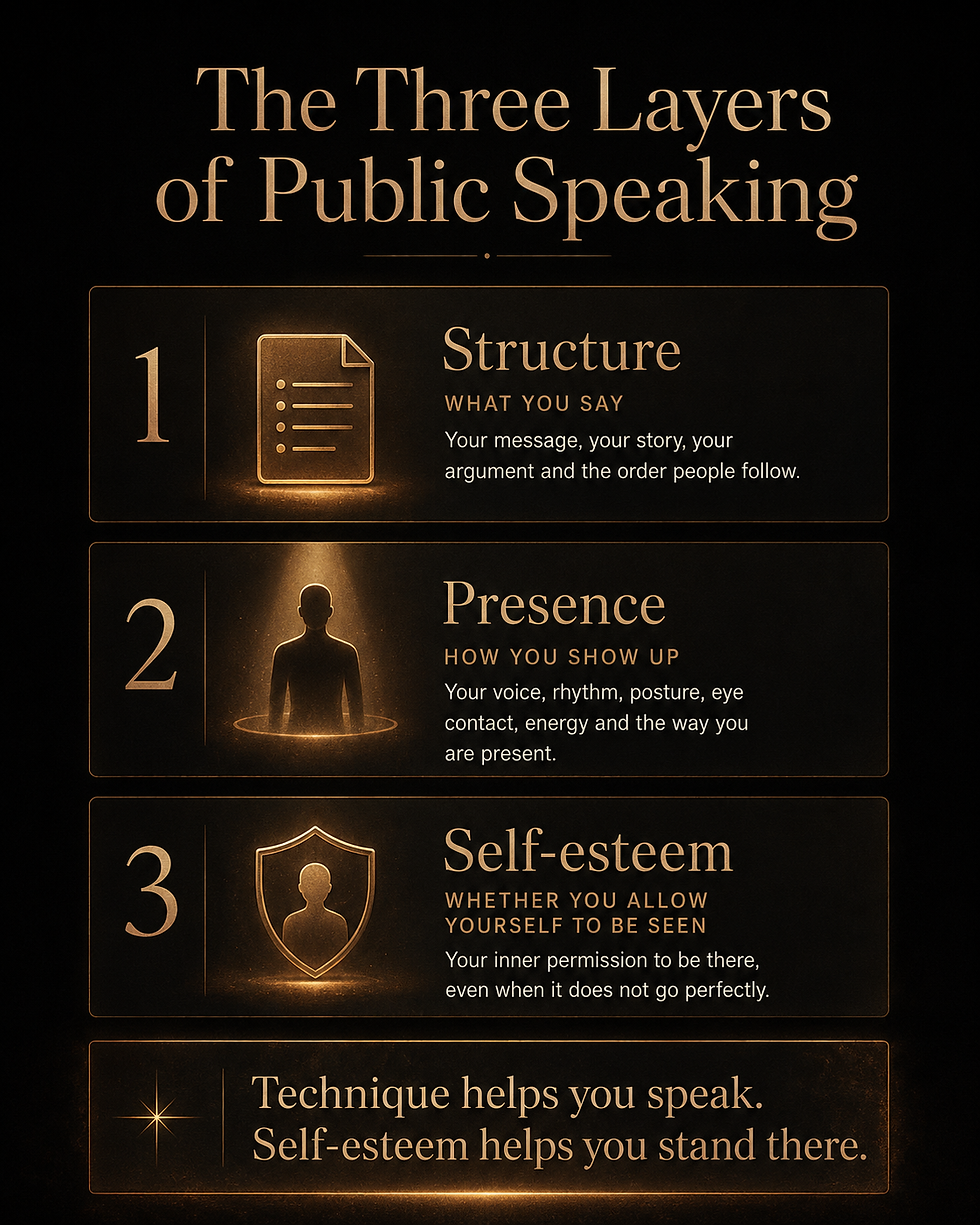
Technique helps you speak. Preparation helps you stay clear. Self-esteem helps you remain present when you are being watched.
And authenticity helps people believe you.
How to Build Self-Esteem for Public Speaking
Building self-esteem is not something you solve with one trick before a presentation. It is a deeper process, and this article cannot cover it completely. Books such as The Six Pillars of Self-Esteem by Nathaniel Branden can offer useful insights, but self-esteem is not only something you understand intellectually. It is something you slowly rebuild in how you relate to yourself.
As children, many of us had a more natural, uninhibited form of self-worth. We sang, danced, drew, asked questions and took up space before we learned to constantly judge ourselves. Over time, experiences, criticism, rejection, shame or comparison can teach us limiting beliefs about who we are and what we are allowed to show.
That is why coaching can be valuable. A good coaching process can help you discover which beliefs are activated when you become visible.
What do you fear will happen?
Where did you learn that?
Whose voice are you still hearing?
What story about yourself are you carrying onto the stage?
Sometimes the work is not to become louder. Sometimes the work is to feel safe enough to speak from where you are.
Practical preparation can support that process. You can start by speaking in front of one trusted person. Then two. Then a small group. You can record yourself, not to criticize every detail, but to become familiar with your own voice. You can practice your opening until your body knows it. You can prepare the structure so well that you have something to return to when nerves appear.
You can also practice saying out loud: “I do not need to be perfect to be worth listening to.”
That sentence may sound simple, but for many people it is exactly where public speaking begins.
Public Speaking and Storytelling Work Together
Public speaking and storytelling are closely connected, but they are not the same.
Storytelling helps you shape meaning. It helps you decide what happens first, where the tension is, what changes and what the audience should remember. Public speaking asks whether you can carry that story in front of others without losing yourself.
A good story can help reduce speaking fear because it gives you a line to follow. Instead of performing abstract information, you take people through a human movement. That gives you something real to hold onto.
At the same time, a good story still needs a speaker who is present enough to let it land. If you rush through it, hide behind slides or speak as if you are apologizing for being there, the story loses power.
So if you want to become better at speaking in front of audiences, do both. Learn to shape better stories, and learn to stand there as yourself while telling them.
That combination is powerful.
FAQ About Public Speaking, Self-Esteem and Authenticity
Why am I afraid to speak in front of an audience?
Public speaking fear is often not only about speaking. It is also about being seen, judged or rejected while speaking. For many people, the fear is connected to self-esteem, perfectionism or old beliefs about visibility and failure.
What is the difference between self-confidence and self-esteem?
Self-confidence is the belief that you can perform a specific task. Self-esteem is the deeper sense that you are valuable, even if you do not perform perfectly. In public speaking, both matter, but self-esteem often determines whether you can remain present when people are watching.
Can authenticity make public speaking easier?
Yes. Authenticity makes public speaking easier because you do not have to waste energy pretending to be someone else. Technique still matters, but an audience often connects more with a real human being than with a polished performance that feels distant or artificial.
How does vulnerability help when speaking in public?
Vulnerability can create trust when it serves the message. Admitting a real feeling, sharing a personal lesson or acknowledging the difficulty of a topic can make your message more human and credible. The key is to use vulnerability to create connection, not to make the audience responsible for your insecurity.
Why is preparation important if authenticity matters?
Preparation gives authenticity structure. Without preparation, even a sincere speaker can become unclear or chaotic. Good preparation helps you know your message, structure and opening, so you can stay present even when nerves appear.
How can coaching help with public speaking fear?
Coaching can help you identify the beliefs and patterns behind your fear. It can also help you strengthen self-esteem, prepare your message, practice visibility and develop a more authentic way of speaking that fits who you are.
Final Thought: You Do Not Need to Be Perfect to Be Worth Listening To
Speaking in front of an audience is not just about technique. Technique helps. Storytelling helps. Preparation helps. But beneath all of that lies a deeper question: can you allow yourself to be seen while still being human?
You may forget a word. You may feel nervous. You may stumble. You may need a second to find your rhythm. None of that means you should not be there.
The best speakers are not always the most perfect speakers. They are often the ones who bring enough structure to be clear, enough preparation to be grounded and enough self-esteem to remain real.
You do not need to become someone else to speak well.
You need to become present enough as yourself.




Comments